
Aviation Tools
Practical tools used by pilots and students for flight planning, navigation, performance, and training preparation.
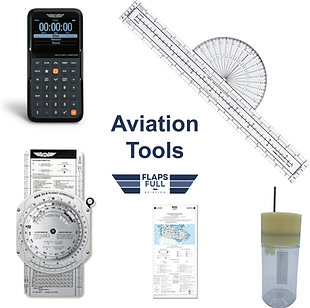
Whether in the classroom, the hangar, or the cockpit, the right tools help pilots work smarter, safer, and more confidently. From digital navigation aids to essential ground-school gear, aviation tools enhance planning, decision-making, and operational efficiency. While technology continues to evolve, many classic tools remain staples in every pilot’s kit. Below are key aviation tools that support pilots through training and real-world flying.

Tools for On the Ground and in the Air
E6B Flight Computer
The ASA E6B is the aviation community’s iconic analog flight computer, long recognized as an essential tool for pilot training and flight planning. Using its rotating discs and slide rule format, pilots can manually compute wind correction angles, groundspeed, fuel burn, estimated time en route, and other key performance figures. Learning to use an E6B builds fundamental navigation skills and deepens understanding of how variables like wind and airspeed interact in real flight.
Learning to use the E6B can be a daunting task. Luckily, Pilot Institute offers a free comprehensive course. Check out our article on essential websites to learn more.
✈️ASA CX3 Flight Computer
The ASA CX-3 is a multifunction flight computer that combines the trusted functionality of a classic E6B with modern enhancements, including speed, distance, heading, wind, fuel, altitude, cloud base, standard atmosphere, glide, climb & descent, weight & balance, as well as a holding pattern function to help determine entry method and holding details. Its durable construction and clear, well-organized scales make it a reliable backup to electronic flight computers and apps. The CX3 can be used on all FAA and Canadian pilot, mechanic, and dispatcher knowledge exams.
Pro tip from experience: always carry spare batteries with you. On my PPL solo cross-country, the batteries in my CX-3 died while I was setting it up for my final navigation departure. Fortunately, I had extra batteries in my flight bag and was able to replace them before takeoff.
Learning to use the CX3 is generally more intuitive than the E6B, but still fairly complex. Pilot Institute also offers a free comprehensive course for the Cx3. Check out our article on essential websites to learn more.
GATs Fuel Jar Strainer
Your flight school should provide a fuel sump cup in every aircraft, but these are often small leaving us with traces of 100LL on our hands. This can be particularly annoying for pilots flying in colder climates.
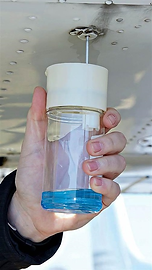
Wanting to find a "cleaner" way to sump fuel, I purchased the GATs Fuel Jar Strainer. This strainer is a simple pre-flight tool for piston-engine aircraft. It attaches to a fuel sample jar and provides a fine mesh filter that pilots use to draw fuel from the aircraft’s tanks to inspect for contaminants like water, sediment, or debris. Clean fuel helps prevent engine roughness, stoppages, or mechanical damage.


✈️Active Noise Reduction (ANR) Headset
Active Noise Reduction (ANR) headsets help pilots reduce the constant roar of engine and wind noise in the cockpit, enhancing comfort and preserving hearing during long flights. Popular brands like Bose, Lightspeed, and David Clark offer ANR models that combine cushioned earcups, effective noise cancellation technology, and clear communications performance. While specific preference varies by pilot, ANR headsets are widely regarded as a valuable upgrade over passive models, reducing fatigue and improving radio clarity.
While nearly every pilot has their own opinion on which ANR headset is best, you really can’t go wrong with any of the three pictured on the right:
-
Bose A30 (the headset I use and personally recommend)
-
Lightspeed Delta Zulu (the headset my CFI uses and recommends)
-
David Clark DC ONE-X (a popular choice among many CFIs I know)
In addition to comfort and audio quality, a high-quality ANR headset plays a critical role in protecting your hearing. Prolonged exposure to cockpit noise can lead to permanent hearing damage over time, and effective active noise reduction significantly reduces that risk, especially for pilots who spend many hours in piston aircraft.
My recommendation: if you have a local aviation store, try these headsets in person. Fit and comfort vary, and many pilots purchase a headset only to later return or resell it in favor of a different model.


✈️Logbook - Physical and Digital
Pilot logbooks are official records where aviators track flight experience, including date, aircraft type, duration, flight conditions, maneuvers, and endorsements. These records are essential for tracking currency requirements, building hours toward ratings, and documenting experience for employers or examiners. While traditional paper logbooks remain popular, many pilots now also use digital logbook.
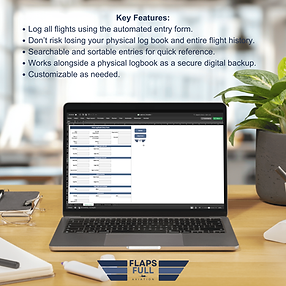
Click here to download our FREE excel logbook. Relying solely on a physical logbook carries the risk of losing your entire flight history if it is lost or stolen. I personally track my hours in three separate places (which admittedly may be overkill): a physical logbook, the Flaps Full Excel logbook, and in Foreflight using track logs.
I recommend that student pilots purchase a logbook after their first lesson or discovery flight. Most flight schools sell logbooks for around $25, and logging your flight time from day one can save both time and money in the long run.

Flightbag
A quality flight bag keeps a pilot’s tools organized and accessible. Designed with compartments for charts, manuals, headsets, tablets, pens, fuel testers, flashlights, and more, flight bags help pilots prepare for both planned and unexpected needs. From compact shoulder bags to larger wheeled models, the right flight bag protects gear, streamlines pre-flight routines, and ensures that everything essential is ready before taxi.
A formal flight bag is not essential; however, some form of bag is necessary to keep your equipment organized and easily accessible. Personally, I use the Lululemon Everyday Backpack (pictured on the right), which works well for my needs. Another popular option is the ASA Pro Flight Bag. A flight bag I particularly like is the Solo Flight Bag from Wairworthy (also pictured on the right), offering quality materials in an organized and compact size.


✈️Knee Board
A knee board is a practical cockpit accessory that keeps essential flight information right in a pilot’s line of sight. The ASA Long Tri-Fold Kneeboard features a large writing surface, secure straps to fasten it to your thigh, with multiple pockets or clips to hold charts, checklists, and pens. A knee board helps pilots stay oriented and reduce workload during busy phases of flight. The ASA tri-fold design provides extra space without sacrificing portability, making it a trusted companion for both student pilots and seasoned aviators who value clear, accessible cockpit information.
I always keep a ringed notebook clipped to my kneeboard. This is especially useful for recording fuel quantities during preflight, noting the ATIS, and writing down ATC instructions. During high-workload or critical phases of flight, it’s easy to forget a clearance or instruction; writing it down improves retention and provides a quick reference if needed.

✈️Nav Canada VNC and VTA
Nav Canada’s VNC (VFR Navigation Charts) and VTA (VFR Terminal Area Charts) are official aeronautical charts that provide detailed mapping for visual flight rules (VFR) navigation across Canadian airspace. VNCs cover broad regions at scales suited for en-route VFR planning, showing topography, controlled airspace boundaries, radio aids, and landmarks. VTAs focus on high-traffic terminal areas around major airports with enhanced detail to support safe transitions and traffic avoidance. These charts are often required for route planning and maintaining situational awareness in the air.

✈️Fixed Chart Plotter
A fixed plotter like the ASA CP-1 (pictured on the right) is a crucial navigation tool designed to work with paper aeronautical charts. It helps pilots accurately measure courses, bearings, and distances between waypoints when planning a VFR flight. With clear, durable edges and integrated protractors, fixed plotters allow you to align directly on VNC or VTA charts to determine headings and distance in nautical miles. While electronic chart plotters and GPS devices offer digital convenience, a fixed plotter remains a reliable and inexpensive backup that reinforces fundamental navigation skills and ensures you can plan and fly confidently even when technology isn’t available.
There are several styles of fixed plotters available. My preferred type is the protractor/ruler style (pictured on the right). However, use caution, as both nautical miles and statute miles are shown on opposite sides of the plotter.

✈️Canadian Flight Supplement (CFS)
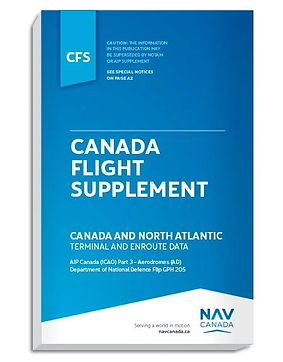
The Canada Flight Supplement (CFS) is Canada’s official civil/military aeronautical publication and a fundamental reference for pilots flying in Canadian airspace. Updated on a 56-day ICAO AIRAC cycle, this paperback directory contains detailed information on all registered Canadian aerodromes and selected North Atlantic airports, including runway data, radio and ATC frequencies, available services like fuel and hangars, airport sketches, planning information, and navigation aids. It’s designed to be used in conjunction with aeronautical charts for both pre-flight planning and in-flight reference, helping pilots safely conduct VFR and IFR operations across the country.
While NOTAMs and other temporary changes can supersede CFS entries, most pilots carry a current copy or have access to current copies (FltPlan Go, Foreflight, etc.) during cross-country flights or when there’s potential for weather or mechanical diversions. Because it consolidates essential airport and facility data not always found on charts alone, the CFS is considered an indispensable part of a pilot’s toolkit in Canadian aviation.
✈️Self Lesson Planner
Prepare for every flight with confidence using a Self Lesson Planner, a proven tool I used on every training flight, both dual and solo. This is the same document I relied on throughout my training to stay organized, focused, and prepared before stepping into the cockpit.
Designed to grow with you, the planner includes concepts that are introduced progressively throughout flight training, such as performance calculations and NOTAM reviews. If some sections feel unfamiliar or intimidating at first, that’s completely normal, these items will become second nature as your training progresses.
Whether you’re preparing for your first lesson or refining skills for a flight test, this planner helps you arrive ready to learn, maximize the value of each flight, and develop the habits of a safe, professional pilot.
Click here to download our Lesson Planner for Student Pilots for free.

Magsafe Window Mount
For pilots who haven’t purchased an iPad yet—or who prefer the compact convenience of using a phone—a MagSafe window mount is a great cockpit accessory.
Compared to traditional mounts, MagSafe makes attaching and removing your phone effortless, as it relies solely on a strong magnetic connection. This allows for quick repositioning without dealing with clamps or adjustment knobs.
I originally used this mount to display ForeFlight on my phone. While I’ve since transitioned to an iPad mini, I still keep the mount in my flight bag. It’s especially useful for passengers who want a convenient and secure place to mount their phone during the flight.

