
PPL Flight Test Prep - Acing your Ground Briefing/Oral Exam

Updated: Jan 11
The Private Pilot Licence Flight Test Ground Briefing, often referred to as the oral exam or ground items, is the first phase of the PPL flight test. All assessments during this portion are completed before you ever reach the aircraft, and your performance here determines whether the flight portion will take place.
The ground briefing consists of the following exercises:
Exercise 2A: Documents and Airworthiness
Exercise 2B: Aeroplane Performance
Exercise 2C: Weight and Balance
Exercise 23A: Pre-Flight Planning Procedures (Navigation)
*Exercise 2F: Operations of Systems (this is an air item, however, it is common for examiners to ask about systems during the ground brief)
With proper preparation, the ground briefing should be the most straightforward part of your flight test. However, it is a mistake to treat this section casually or assume you can “wing it.” Any failure on a ground exercise results in a complete failure of the flight test, and the flight portion will not be conducted. Unlike air exercises, there is no opportunity for a partial re-test on ground items.
The ground portion is an open-book exam (there are only three items you must memorize: Vx, Vy, and Va), meaning you can reference materials to support your explanations. Examples of acceptable resources to reference include, but are not limited to:
Canadian Aviation Regulations (CARs)
Aeronautical Information Manual (AIM)
Aircraft Pilot Operating Handbook (POH)
Your Flight Test Binder (see below)
VFR Navigation Chart (VNC) legend
While you may reference these materials, relying on them too frequently because you don’t know the answers can undermine your confidence in the examiner’s eyes.
In this article, we will break down each exercise, outline what is required, explain what the examiner is looking for, and share real-world questions that examiners have asked during PPL ground briefings.

Navigate this Article
Exercise 2A: Documents and Airworthiness
A - Certificate of Airworthiness
R - Certificate of Registration
Day VFR Equipment Requirements
Ex. 2A - Common Examiner Questions
Exercise 2B: Aeroplane Performance
Exercise 2C: Weight and Balance
Exercise 23A: Pre-Flight Planning Procedures (Navigation)
Setting up your Exam Room
Many candidates prepare thoroughly for the ground briefing, ensuring they understand the required topics and can answer the examiner’s questions. However, one critical element is often overlooked: how the information is presented to the examiner. This may seem like something you can figure out on the spot, but as with anything in aviation, failing to plan is planning to fail.
How you set up the briefing room, how organized your materials are, and how you present yourself set the tone for the flight test. A clear, well-structured, and professional ground briefing builds examiner confidence and creates a positive first impression as you move into the flight portion of the test. So, that leaves the question:
What should you have laid out on the briefing table?
Ultimately, you want to have every document required for the ground items assessable to you. Here are the items you should have ready on the briefing table:
Your documents (AROW-JIL) - Ex. 2A
Your completed VNC (most recent version with track and drift lines) - Ex. 23A
Completed ICAO flight plan - Ex. 23A
Your completed navigation planning and weather package - Ex. 23A
The most recent Canadian Flight Supplement (CFS) - Ex. 23A
Your flight test binder (optional, but recommended)
If you have all of the documents organized and ready for the examiner, it (1) shows you are prepared and (2) provides a natural way for you and the examiner to progress through the ground brief.
Exercise 2A: Documents and Airworthiness
At a high level, Exercise. 2A verifies that you:
Understand which documents are required to be carried on board
Can determine whether those documents are valid
Can assess whether the aircraft is airworthy
The Transport Canada Flight Test Guide defines the aim of this exercise as: To correctly assess the validity of documents required on board and, from these documents, determine that the aircraft is airworthy for the proposed flight.
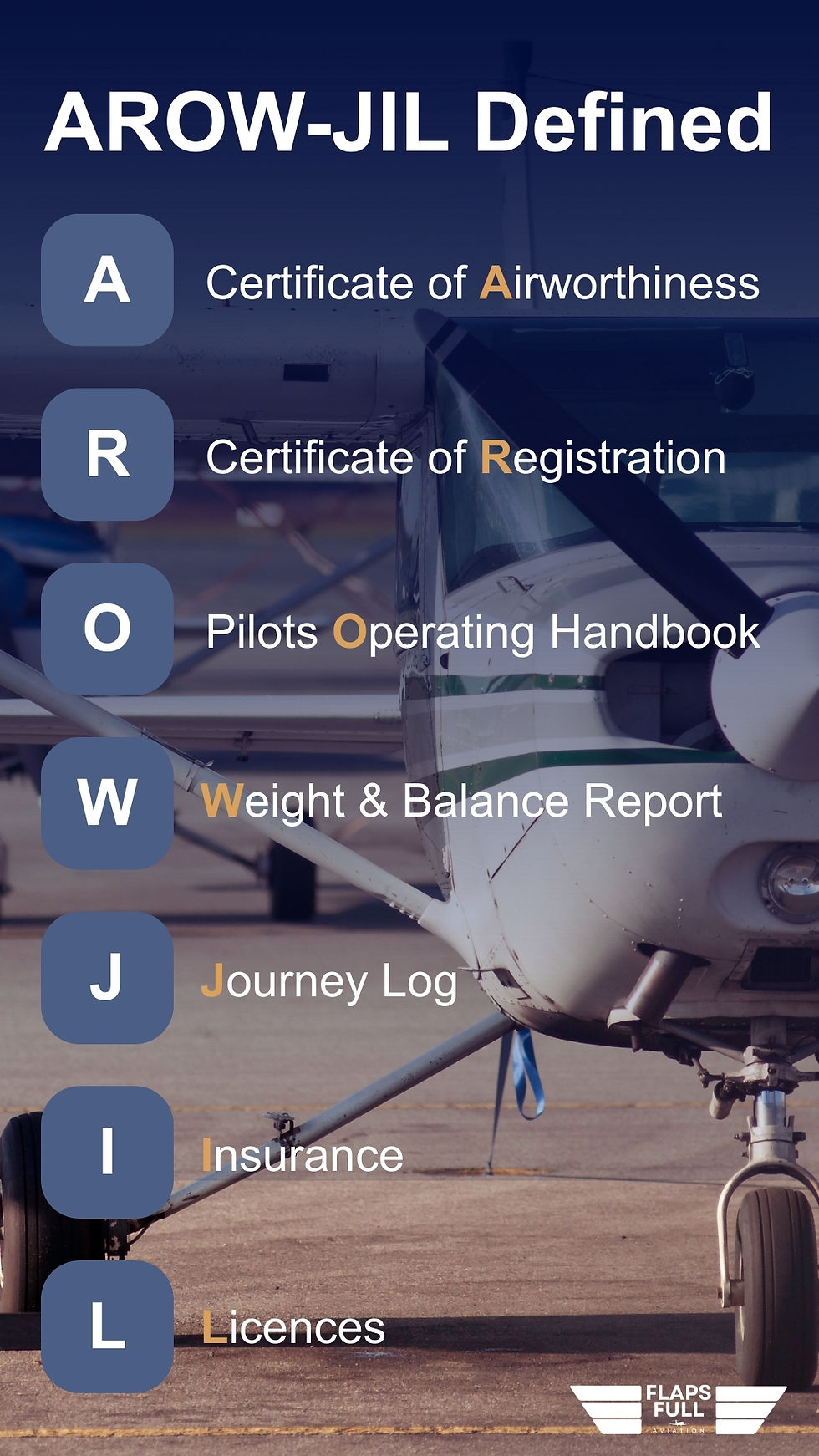
The majority of information you need to know for Ex. 2A can be summarized into the acronym AROW-JIL:
A - Certificate of Airworthiness
R - Certificate of Registration
O - Pilots Operating Handbook
W - Weight & Balance Report
J - Journey Log
I - Insurance
L - Licences
If all of these documents are present and valid, the aircraft will be considered airworthy on paper. However, the examiner is specifically looking for confirmation that you understand:
The purpose of each document
The requirements that make each document valid
What conditions or circumstances would invalidate each document
A - Certificate of Airworthiness

Purpose & Authority
A Flight Authority issued by Transport Canada that certifies a particular aircraft as airworthy, meaning, the aircraft conforms to TC recognized design standards and is considered fit and safe for flight on the date of the certificate.
Requirements & Validation
The Certificate of Airworthiness (C of A) is valid indefinitely, provided the aircraft continues to meet the conditions under which it was issued. Its validity is maintained through the completion of required maintenance and calendar-based inspections, and by operating the aircraft in accordance with the limitations specified in the Pilot’s Operating Handbook (POH).
Invalidation
The C of A is considered invalid if:
Failure to comply with Airworthiness Directives (AD)
Failure to perform required maintenance at the required intervals
An action that contradicts the POH
Any minor or major accident
Any unscheduled maintenance (snag) written in the Journey Log
R - Certificate of Registration
Purpose & Authority
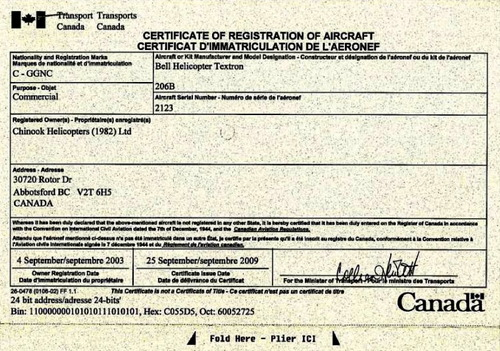
The C of R confirms the aircrafts legal registration in Canada and contains the following information:
Nationality and registration marks (C-GGNC)
Aircraft manufacturer, model, and serial number
Purpose (either private, commercial, or state)
Registered owner(s)
Requirements & Validation
The C of R remains valid as long as there is no change in (1) owner, (2) owner’s address, or (3) purpose. TC must be notified in writing within 7 days of any changes
Invalidation
C of R will become invalid if the aircraft is permanently destroyed, withdrawn from service, or there is a change in ownership.
O - Pilots Operating Handbook
Purpose & Authority

The Pilot’s Operating Handbook (POH) contains essential information about the aircraft, including normal and emergency procedures, performance data, and operating limitations. It allows pilots to reference critical information both on the ground and in flight. In addition, the POH lists all installed equipment and identifies whether each item is required or optional.
Pilots should have a functional understanding of the content within their POH as you may not have time to review during flight, such as during emergencies.
Requirements & Validation
The aircraft must be operated in accordance with the POH to maintain the validity of the C of A. You can determine if the POH is for your aircraft by matching the registration and serial to the particular aircraft.
W - Weight & Balance Report

Purpose & Authority
The Weight and Balance (W&B) Report provides the aircraft’s Basic Empty Weight and the associated values, including:
Centre of Gravity
Moment
Useful Load
These values are specific to the individual aircraft. The original report is issued by the manufacturer and includes additional details such as the date of manufacture, the actual usable fuel quantity, and the full oil capacity.
It is important to note that this report is not the weight and balance calculation completed before each flight, but rather the baseline data used to perform those calculations.
Requirements & Validation
If the aircraft weighs more than 12,500 lbs, it must be re-weighed every three years.
Invalidation
The current W&B Report expires if a weight change cannot be measured (ex, re-painting the aircraft). The Journey Log will show if the most current report is being used.
J - Journey Log
Purpose & Authority

The Journey Log is a comprehensive record that documents the aircraft’s flight time (air time), airworthiness status, and maintenance history. It must be carried on board for all flights, except when it is not intended that the aircraft will land and shut down at any location other than the point of departure.
Requirements & Validation
Entries must be made in the Journey Log after each flight (or as soon as practicable). If the operator uses an approved flight sheet system, accumulated daily flight time may be entered at the end of the day.
All entries are recorded as air time, as maintenance inspections are based on air time rather than flight time.
Journey logs must be retained for a minimum of one year.
Maintenance inspections are recorded in the journey log and include the next required inspection, listed by both air time and calendar date. An inspection interval may be exceeded by up to 10 hours if an Aircraft Maintenance Engineer (AME) has provided written confirmation authorizing the extension.
Invalidation
An aircraft is not legal to fly is a snag is reported in the Journey Log until the problem has been deferred or rectified by an AME.
I - Insurance
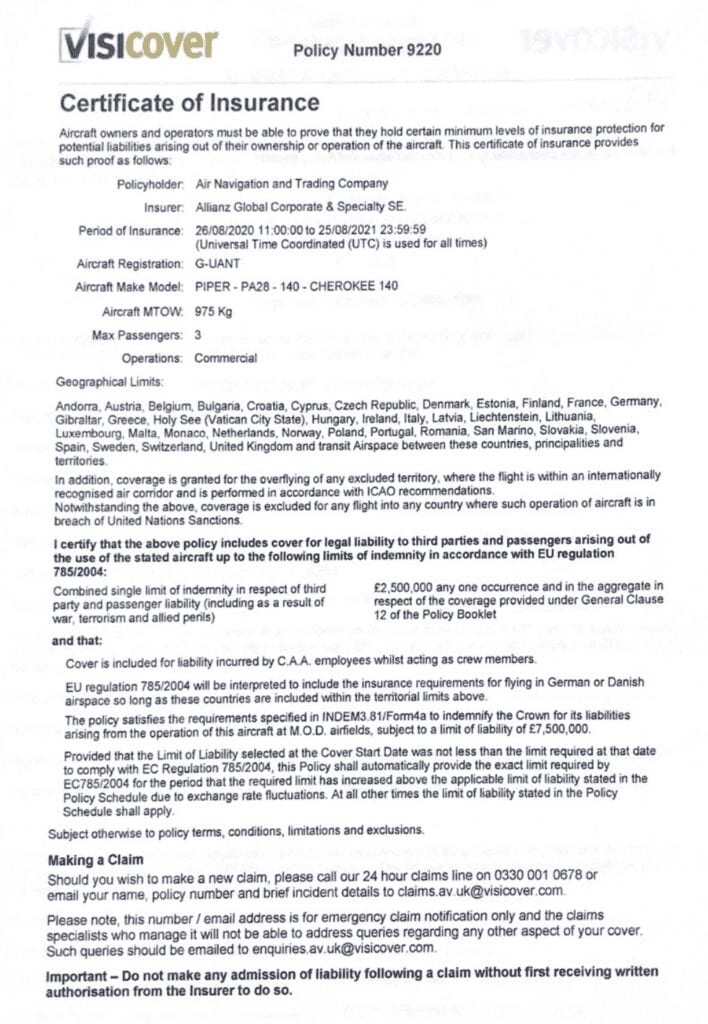
Purpose & Authority
Provides proof of financial coverage in the event of accidents, damage, or liability.
Requirements & Validation
Proof of insurance must be carried on board for all flights.
Public Liability or Third-Party Liability Insurance
Damage externally done by the aircraft
Required on board for all aircraft
Passenger liability
Covers injuries to passengers on board
Optional for private, required for commercial operations
Hull insurance
Covers damage to the aircraft itself
Optional
Invalidation
Invalidated if expired or cancelled.
L - Licences
Purpose & Authority
Proves the pilot’s competency, medical fitness, and legal authority to operate the aircraft.
Requirements & Validation
Must carry on-board for all flights.
Valid Licensing Booklet that is not expired, is signed by the holder, and contains a valid Medical of the appropriate class
Radiotelephone Operator’s Certificate
Student Pilots must have the following with them:
Student Pilot Permit
For the purpose of training flight and under supervision, may act as PIC of an aircraft not carrying passengers.
Valid Medical Document
Radiotelephone Operator’s Certificate
Invalidation
Invalidated if expired. Ex, if your medical is expired then your licence is invalidated.
Day VFR Equipment Requirements
In addition to AROW-JIL, the examiner may also ask you to explain the equipment is required for day VFR flight. We use to acronym MOOFACTAR to explain this at a high level (derived from CAR 605.14):
M – Manifold Pressure Gauge
O – Oil Temperature Gauge
O – Oil Pressure Gauge
F – Fuel Quantity Indicator
A – Airspeed Indicator
C - Compass
T - Tachometer
A - Altimeter
R – Radiocommunication/nav as needed
Note, many piston trainers will not be equipped with a manifold pressure gauge. In that case, it is not a required equipment.
Tips for Success
Review the Journey Log in advance and use sticky notes to clearly mark all calendar-based items. Determine when the next maintenance interval is due and how much time remains on the aircraft. Be prepared to explain when each maintenance or inspection item was last completed and when it is next due, including:
ELT Inspection
Compass Swing
W&B Report
Last Maintenance Interval
Fire Extinguisher Inspection
First Aid Kit Inspection
Pitot-Static Inspection (required for IFR operations or VFR in class B airspace)
Practice presenting each document out loud.
Ex. 2A - Common Examiner Questions
AROW-JIL
Certificate of Airworthiness
What invalidates the C of A?
What re-validates the C of A?
Certificate of Registration
What are the three purposes?
Does a change of ownership affect the validity of the C of R?
What invalidates the C of R
Pilots Operating Handbook
Can you use any POH for a particular model?
How do you know this POH is for your aircraft?
What section of the POH would you use to determine is a piece of equipment is required?
Is the aircraft still airworthy is you operate beyond the limitations of the POH? Why or why not?
Weight & Balance Report
What is the basic empty weight of your aircraft?
When do you have to re-weigh the aircraft?
If you were to instal a new GPS, do you have to re-weigh the aircraft?
Journey Log
Prove to me that this aircraft is airworthy
Explain to me how you would write a snag
Can you fly with a snag?
How much time is left on this aircraft?
Can you fly an aircraft past its next maintenance interval?
What maintenance intervals is this aircraft on?
Insurance
How do you know the insurance is valid?
Licences
How much time is left on your medical?
What medical do you need for a PPL?
Day VFR Equipment
You find that your landing light is burnt out during your walk around. How does this impact your flight? Can you fly?
You notice that the pitot-static inspection is overdue. Can you still fly the aircraft for this flight?
The GPS is unserviceable and it has been deferred by and AME. Can you fly?
Exercise 2B: Aeroplane Performance
At a high level, Exercise 2B will verify that you:
Understand the performance and capabilities of your aircraft
Understand different factors that impact the performance of your aircraft
It is required that you can stated the following speeds and their applications from memory:
Vx - best angle of climb (most altitude in the least amount of distance)
Vy - beast rate of climb (most altitude in least amount of time)
Va - maneuvering speed (the maximum speed at which full deflection of the controls can be made without over-stressing the aircraft)
Va - Maneuvering Speed
Many candidates struggle with the concept of maneuvering speed. There are a few key points the examiner is looking for:
Va changes with weight. As the weight of our aircraft increases, Va increase. For example, in my flight test aircraft (C172R w/180HP engine), Va was:
2550 pounds: 105 KIAS
2150 pounds: 98 KIAS
1900 pounds: 90 KIAS
Va is also our turbulence penetration speed
Flying at a speed less than Va means our aircraft will stall rather then bend or break when we impose or have a load imposed on us (ex, turbulence)
Va increases with weight because it is directly related to stall speed. As aircraft weight increases, the stall speed increases. At any given airspeed, a heavier aircraft must fly at a higher angle of attack to produce the required lift, meaning it reaches the critical angle of attack, and therefore stalls at a higher airspeed.
You will also be required to calculate the following for the proposed cross country and demonstrate how you completed the calculations:
Take-off distance required to clear a 50 foot or existing obstacle;
Landing distance required to clear a 50 foot or existing obstacle;
The power setting proposed for the planned en-route cruising flight (percentage, manifold pressure and RPM) and the expected cruise speed in KTAS;
The available flight time with the fuel load and power settings proposed for the navigation flight;
Density Altitude
Although not explicitly stated in the flight test guide under Exercise 2B, my examiner asked me about density altitude, and specifically how it impacts aeroplane performance. There were two specific concepts the examiner was looking for:
How density altitude affects aircraft performance (engine develops less power, wings produce less lift, and propeller produces less thrust)
The conditions that lead to a higher or lower density altitude (elevation, temperature, humidity, atmospheric pressure)
Ex. 2B - Common Examiner Questions
State Vx, Vy, and Va from memory.
What are the practical applications of Vx? Vy? Va?
Why does Va change with weight?
Why does the aircraft stall at a higher airspeed when it is heavier?
How does density altitude affect aircraft performance?
What can help an aircraft operate at high altitudes, or with high density altitude?
Is this aircraft carbureted or fuel injected?
What is the benefit of fuel injection?
What is the benefit or a carbureted engine?
What are symptoms of carb ice?
What would you do if you detected carb ice?
What would you expect if you turned on carb heat when there was carb ice?
You notice your oil temp is gradually rising beyond where is normally is, but it is not excessively high. What would you do? Is there anything you can do to cool the oil temp?
Exercise 2C: Weight and Balance
The aim of Ex. 2C is to correctly complete two weight and balance calculations for the aeroplane used for the test, one for the planned simulated VFR cross-country flight prepared in Ex 23 A and the second calculation for the actual flight-test flight.

On the day of my flight test, I had two W&B calculations prepared and plotted for both legs of the proposed cross country. On each graph I plotted the take off weight, landing weight, and zero-fuel weight.
In the proposed cross country, the examiner provided me with weights for the cargo, but did not specify the weight of passengers. You can find the weights to use in AIM RAC 3.4.7.
I completed the W&B for the actual flight in front of the examiner, as I didn't know until that morning: (1) exactly how much fuel was in the aircraft, (2) the weight of the examiner, and (3) if the examiner was brining any gear with him that would add additional weight.
Ex. 2C - Common Examiner Questions
How would you adjust the W&B of your aircraft if it wasn't within limits?
Can you fly if your W&B is not within limits? Why not?
What is the risk of W&B being out of limits?
Could the aircraft become out of CG during the flight? Why or why not?
How does a rearward C of G impact performance? Frontward?
What is the significance of zero fuel weight? Why is it important to know?
Exercise 23A: Pre-Flight Planning Procedures (Navigation)
The aim of Ex. 23A is to efficiently plan a VFR cross-country flight and demonstrate practical knowledge by explaining elements related to cross-country flight planning.
At the end of this section that examiner will ask you if you would fly this cross country based on your planning and current conditions, and why or why not?
Description
The candidate will plan a VFR cross-country flight, including one intermediate stop, to an assigned destination at least 2 hours cruising range distance in the aeroplane being used for the flight test.
The cross-country flight can be assigned in advance and the candidate can make preliminary preparations such as route selection, paper chart preparation, determination of tracks, distances, selection of possible alternates and initial navigational log entries before the flight test.
Flight planning will be completed based on real-time weather and a loading scenario with all or most passenger seats occupied and a significant baggage load, as specified by the examiner.
Software-generated flight planning is acceptable, but the candidate must be able to explain some of the key elements of flight planning such as estimated time en-route, fuel requirements, contingencies, etc.
VNC/Chart Preparation
You must have a VNC prepared with your proposed routing and 10 degree drift lines. A few items the examiner will look for:
Your departure procedure (set heading point, overhead, etc.)
The points you chose for ground speed checks
Why you chose a particular routing
Navigation Log & Calculations
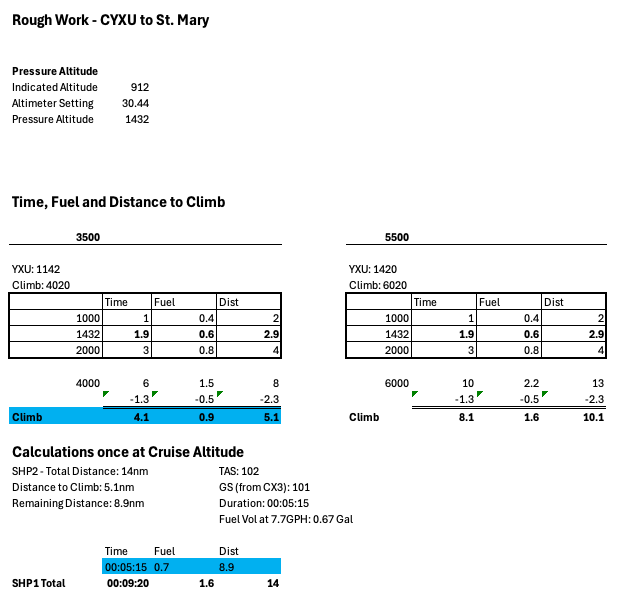
You must have a fully prepared navigation log with your completed performance
calculations. It is not enough to simply explain how you calculated your numbers, you must also have your rough work ready to present.
I prepared calculations for the following:
Set Heading Points - time, fuel, and distance to climb for both 3,500 and 5,500 feet
Legs One and Two - total fuel burn and duration for 2300, 2400, and 2500 RPM and at 3,500 ft or 5,500 ft
Take off and landing distances for all three airports (ground roll and over a 50ft obstacle)
My rationale for completing and demonstrating calculations at multiple altitudes and power settings was to clearly support my decision-making process for selecting the altitude and power setting I ultimately chose. In doing so, I was able to demonstrate that all reasonable options had been considered and evaluated.
Pre-Flight Planning & Weather Briefing Package

You must be able to present a comprehensive weather briefing to the examiner. For my preparation, I completed the following:
I plotted my planned route on all six Graphical Area Forecasts (GFAs), three Clouds and Weather charts and three Icing and Turbulence charts, so the examiner had a clear visual reference of the forecast conditions affecting the flight. I added written remarks to each chart explaining the key features and what I was interpreting from each GFA.
I called London FIC to obtain an official weather briefing. The information provided by the briefer was recorded in the remarks section of the GFAs to further support my interpretation.
I printed the relevant METARs, TAFs, upper wind forecasts, and NOTAMs for the three airports along the proposed route, as well as both alternates for each leg (a total of four alternates). As a best practice, I highlighted only the information relevant to the planned flight, particularly within the TAFs and upper winds, to make it clear to the examiner which data was being used in my decision-making.
Since Transport Canada permits software-generated flight planning, I also planned the route in ForeFlight and ran a full briefing. While I did not use this as my primary source of information, I used it as a secondary reference to verify and cross-check the data I had already gathered.
ICAO Flight Plan
The Flight Test Guide requires that an ICAO Flight Plan be prepared. I had a completed flight plan ready and visible for the examiner to review, although it was not requested during the briefing. Regardless, it is essential to have this prepared in advance. Do not risk failing your flight test over something as straightforward as completing the ICAO Flight Plan form.
Canadian Flight Supplement
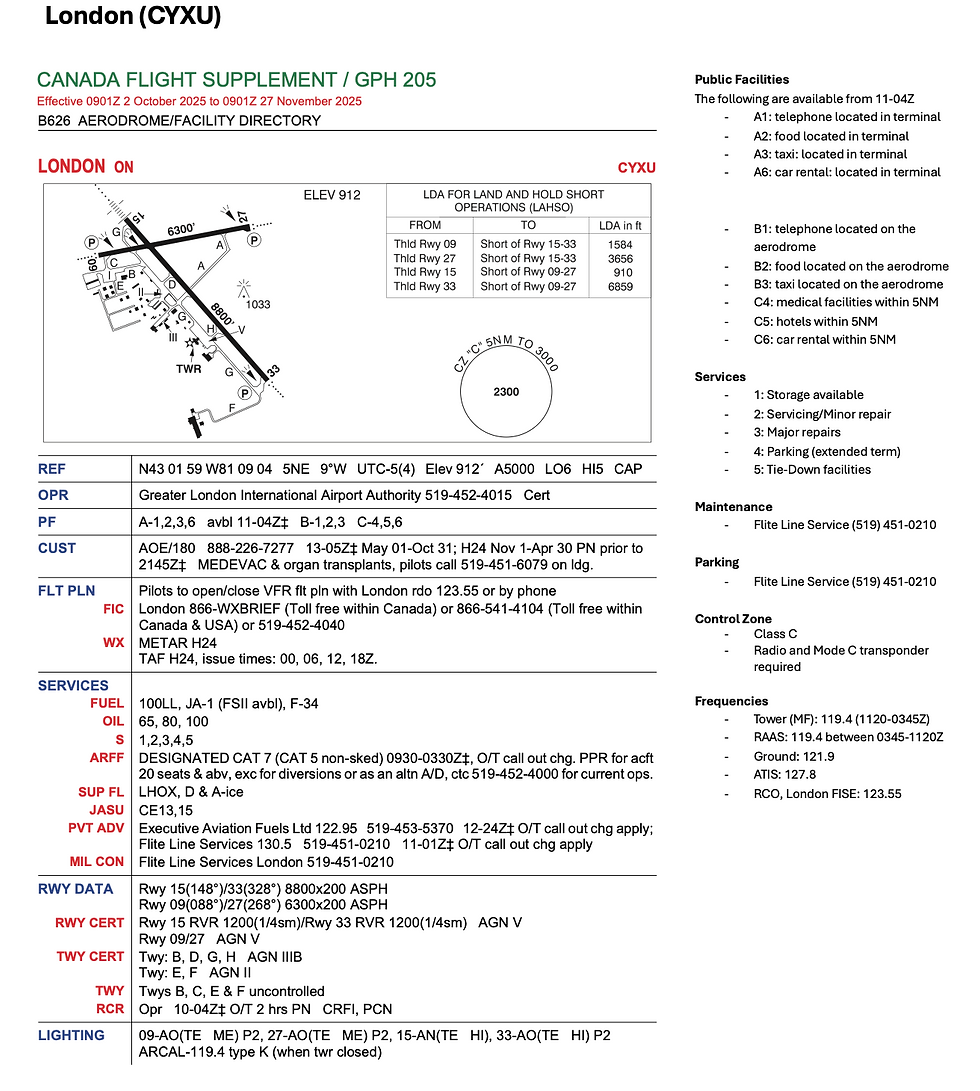
I prepared the Canada Flight Supplement (CFS) in two ways:
I had the most current edition of the CFS available for reference.
Using ForeFlight (FltPlan Go also works), I printed the CFS pages for each airport along my route, including all planned alternates.
On the printed CFS pages, I added remarks highlighting key operational details, including:
Available public facilities
Available services
On-site maintenance contact information (if applicable)
Parking and tie-down information
Airport frequencies and surrounding airspace
I also highlighted relevant information from the CFS, including:
Airport elevation
If fuel or oil for my aircraft was available
Frequencies, specifically was it a towered airport, uncontrolled with an MF or ATF, etc.
Anything notable in the procedures section (ex, right hand circuits)
Bonus Points
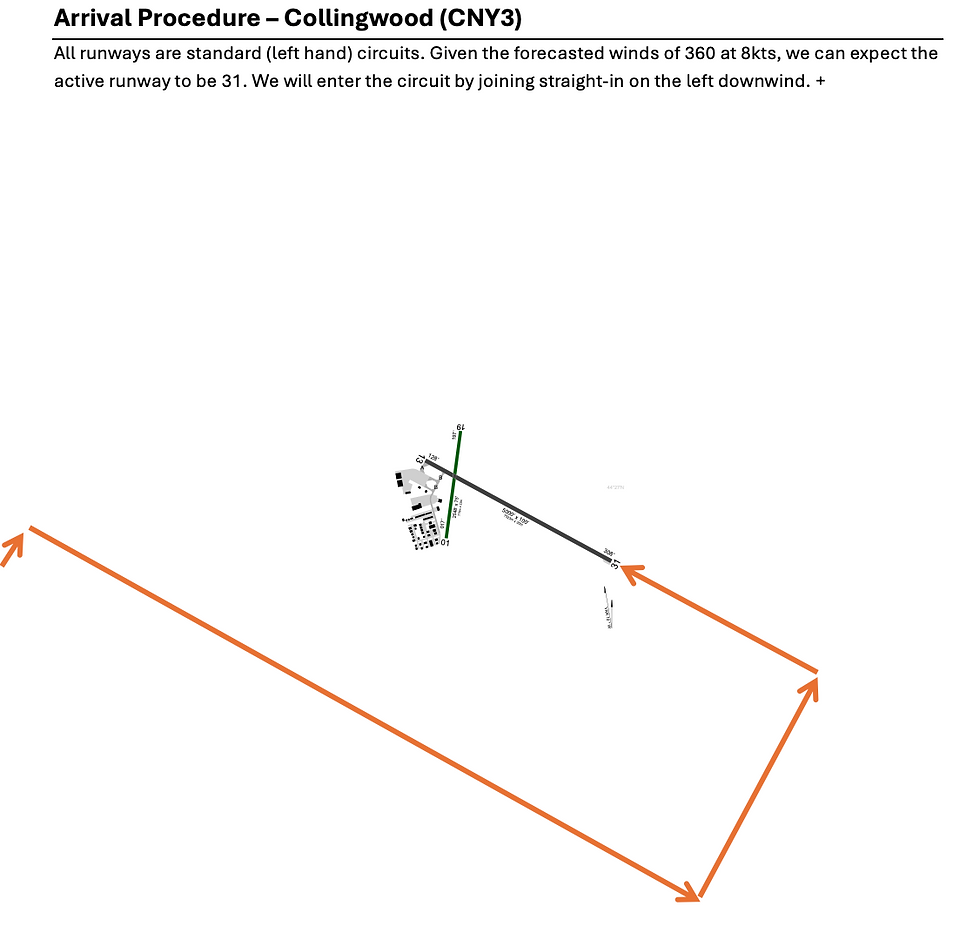
Although not required, the examiner appreciated that I had planned my arrival procedure into the uncontrolled airport. In addition, while this was not written down, I explained the altitude at which I intended to join the circuit.
Tips for Success
When planning your cruising altitude, consider more than just VFR cruising altitudes, wind optimization, or fuel efficiency. While I selected 3,500 feet for both legs because it offered the lowest fuel burn and most favourable winds, the second leg included terrain elevations approaching 1,500 feet ASL. This reduced my altitude to approximately 2,000 feet AGL in some areas. The examiner noted that 5,500 feet would have been the safer choice in the event of an engine failure, offering greater glide options and decision time.
On my VNC, I marked the point at which I would be approximately five minutes from the uncontrolled airport along my route. This allowed me to anticipate when to make my initial radio call.
Know your units! ASL or AGL? True or Magnetic? Know what units of your flight planning and understand what the examiner is referencing.
In addition, ensure that you:
Review NOTAMs for all airports and aerodromes involved, as well as any that may affect your planned route
Select large, easily identifiable landmarks for ground speed checks
Ex. 23A - Common Examiner Questions
Explain your route and planning to me.
Why did you select your set heading point and ground speed checks?
Why not choose a direct route?
How did you calculate your winds aloft?
What is the minimum VFR weather conditions at this point on your route?
How long is this TAF valid? When can you expect the next TAF?
What are these markings on your VNC? (power lines, abandoned aerodrome, heavy box around an airport name, etc.)
What is the ground elevation at this point?
What is the MEF at this point?
Can you fly above the freezing level? If so, when? If not, why?
The GFA is forecasting TCU clouds along your route. What weather can you expect?
How did you calculate your BHP? Why did you choose this power setting?
Why did you choose to take this amount of fuel?
How did you determine your cruising altitude?
What can you learn about airport X from reading the VNC?
What type of airspace if this airport in?
What airspace are you in along this point on your route? How do you know?
What is the difference between a Class D and C CZ? What do you need to enter this airspace?
How would you join the circuit at an uncontrolled aerodrome?
If you were approaching a circuit from the active side, what would you do?
Why was you take-off distance longer at your departure airport compared to the first airport on your route?
What is your endurance for leg one? Leg two?
How would you adjust your power setting for an unplanned tail/headwind en-route?
What is the difference between and ATF and MF?
Why did you choose the runways you did?
Airport X does not have a TAF. How did you find the forecasted winds?
What would do when flying into a Class E CZ?
Let's say you are 5 degrees off track at this point. How would you regain track? Once back on track, what would you adjust?
What radio calls would you make when approaching an uncontrolled airport? What frequency?
Once you land, how would you contact FIC to close your flight plan?
Is there food available at your final destination?
Exercise 2F: Operation of Systems
Note: Although Exercise 2F is classified as an air item, examiners will typically ask systems-related questions during the ground briefing. During the flight portion of the test, you then demonstrate your ability to properly operate these systems.
The examiner will ask you to describe two aircraft systems. You should be prepared to give a high-level overview of each requested system and, when more detailed information is required, reference the appropriate section of the POH.
Common systems the examiners ask for:
Fuel system
Primary flight controls, flaps, and trim
Electrical system
Engine
Brakes and landing gear
Pitot-static
Heater and environmental controls
Any other system you may have
Ex. 2F - Common Examiner Questions
Describe X system to me.
Fuel System
If you summed water out of the fuel tank, what would you do?
What is the usable and unusable fuel for this plane?
Where are the fuel tank vents on this plane? Are there more than one?
What type of fuel system does this aircraft have?
Primary Flight Controls
What type of flaps does this aircraft have?
Can you still use all flight controls in the event of an electrical failure?
Electrical System
What would an electrical failure in flight impact? Could you still fly?
Engine
Describe the engine to me.
What does direct drive mean?
What type of oil does this aircraft take? Where do you find this information?
Brakes and Landing Gear
What would you do if you discovered a brake fluid leak?
When is a tire considered unsafe?
Pitot-Static
What impact would a blocked pitot tube have?
What would a blocked static port impact?
Other
What issues would a chip in the prop cause
You notice your oil temperature is excessively high and oil pressure is excessively low. What could this mean, and what would you do?
Additional Common Questions
What are the privileges and restrictions of a PPL?
If a relative wanted to pay you to fly them to Toronto, can you do that?
If you take friends or family for a scenic flight, can they cover part of the cost?
What are the recency requirements for your licence?
If you have completed your written exam, your examiner may ask to review your results sheet and then ask you specific questions on the incorrect items.
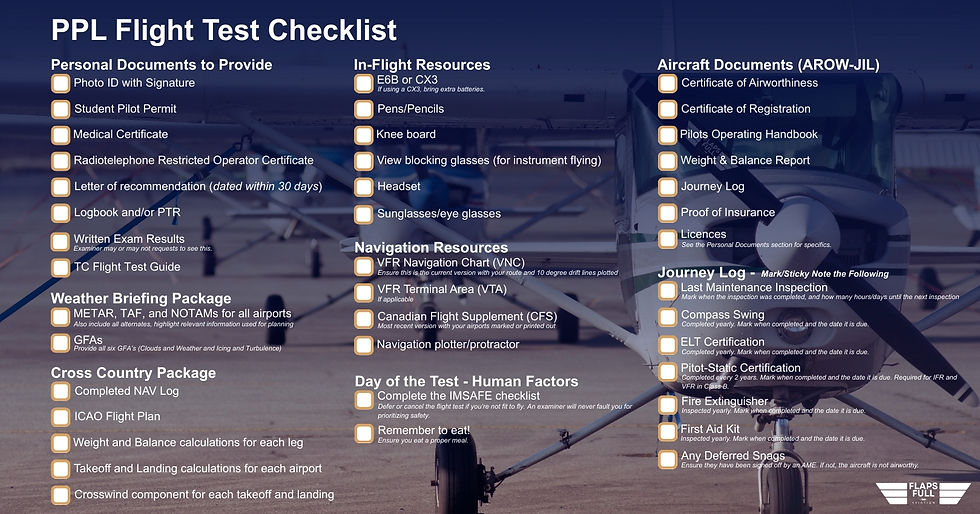
Thorough preparation sets you up for success during the ground briefing. Remember, once the examiner says, “Let’s go flying,” you know you’ve passed.
Questions? Comments? Feedback? Let us know: contact@flapsfull.com
Wishing you blue skies and tailwinds ✈️

Comments